Many hydraulic systems suffer sudden burst or internal leakage; the root cause is not a wrong pressure calculation, but the inner tube drinking the wrong oil. Hydraulic hoses all look like black rubber, yet choosing the wrong inner-tube material can scrap an entire hose within a few hundred hours. This article clarifies the matching relationship between the four mainstream inner-tube materials (NBR, EPDM, FKM, PTFE) and common hydraulic media, providing a ready-to-use reference table for selection.
I. The inner tube is the hose's first line of defense against the fluid
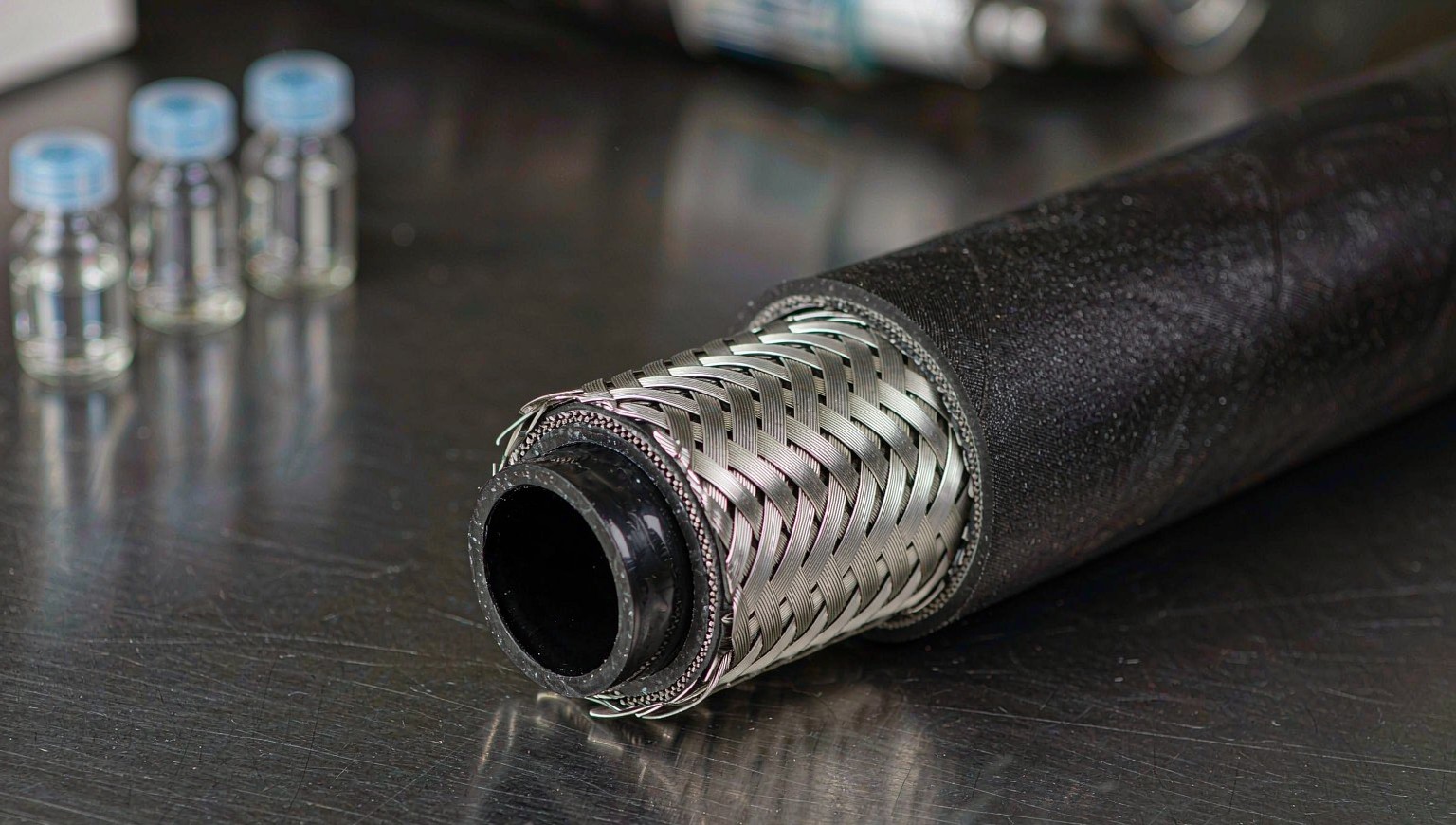
- A hydraulic hose is a multi-layer structure: the inner tube contacts the medium directly, the reinforcement layer bears the pressure, and the outer cover resists environmental attack — each layer performs its role.
- Choosing the wrong inner-tube material causes the elastomer to swell, harden, soften, or crack, leading to leakage and reinforcement corrosion, and eventually sudden burst.
- There is no one-rubber-fits-all-fluids universal material; the inner tube must follow the chemical family of the system medium.
- The easiest pitfall occurs when changing the medium (especially temporary substitution); always check the fluid manufacturer's Safety Data Sheet (SDS) first, and never judge by appearance.
II. NBR (Nitrile Rubber): the universal first choice for mineral oil systems
- Suitable for: mineral oil-based hydraulic oil (AW32/46/68, ISO VG 32/46/68, HL/HLP), diesel, lubricating oil, grease, compressed air.
- For water-glycol (HFC) and oil-water emulsion (HFA/HFB), usable in most cases; the specific formulation must be confirmed with the manufacturer.
- Not suitable: phosphate-ester fire-resistant fluids (HFD-R, causes severe swelling); ketones and strong polar solvents.
- Operating temperature: standard -40C to +100C, instantaneous up to +120~125C; low-temperature grade down to -55C.
- Acrylonitrile content is typically 28%~40%; the higher the content, the better the oil resistance but the poorer the low-temperature flexibility, and manufacturers tune the balance accordingly.
III. EPDM (Ethylene Propylene): exclusive for water-based and fire-resistant fluids
- Suitable for: water, steam, water-glycol (HFC), phosphate-ester fire-resistant fluid (HFD-R), emulsion, brake fluid (DOT), alcohols, weak acids and alkalis.
- Not suitable: mineral oil, diesel, lubricating oil — on contact with oil it swells and softens, and pressure-bearing capacity fails directly.
- Highly saturated molecular chain gives excellent resistance to ozone, ultraviolet, and thermal aging; suitable for outdoor and high-temperature environments.
- Operating temperature: -50C to +150C (steam-specific grade can be higher).
- Typical scenarios: circuits in steel mills, foundries, mines, and similar sites that use water-based or fire-resistant fluids.
IV. FKM (Fluoroelastomer, Viton): the professional solution for high temperature and phosphate ester
- Suitable for: phosphate-ester fire-resistant fluid (HFD-R), high-temperature mineral oil, aromatic fuels, silicone oil, aviation fire-resistant fluid (Skydrol).
- Not suitable: ketones, low-molecular-weight esters.
- Upper operating temperature limit is about +200C, suitable for high-temperature or special circuits where NBR has failed.
- Cost is significantly higher than NBR; it is only cost-effective when the application exceeds NBR's envelope.
V. PTFE (Teflon): the last resort for extreme chemical compatibility
- Compatible with almost all hydraulic media, including concentrated acids, aromatic solvents, chlorinated solvents, and high-temperature synthetic esters.
- Operating temperature -73C to +260C; it is the only inner tube that stably covers high-temperature chemical service.
- Trade-offs: high cost, high rigidity, impulse life lower than rubber, cannot be twisted during installation, requires a special crimping tool, and is mostly reinforced with stainless steel braid.
- Mostly used in chemical, semiconductor, and food/pharma grade CIP circuits; for standard hydraulic applications it is usually not cost-effective.
VI. A quick reference table for medium and inner-tube matching
Hydraulic medium (DIN/ISO family) | Recommended inner tube | Not recommended
| --- | --- | ---
Mineral oil HL / HLP | NBR | EPDM
Water-glycol HFC | EPDM / PTFE | Standard NBR (use with caution at high temperature)
Phosphate ester HFD-R | FKM / PTFE | NBR, EPDM
Oil-water emulsion HFA / HFB | EPDM / NBR (must confirm) | -
Synthetic ester HEES / HFDU | Advanced NBR / FKM (must verify) | -
Steam / hot water | EPDM / PTFE | NBR
VII. Selection checklist and pitfall reminders
- First confirm the chemical family of the system medium (check the fluid SDS), then determine the inner tube: mineral oil to NBR; water-based/fire-resistant to EPDM; phosphate ester to FKM/PTFE; extreme corrosion to PTFE.
- Check the operating temperature range, including instantaneous peaks and low-temperature environments; select low-temperature or high-temperature grade inner tube when necessary.
- Beware of temporary oil change: connecting an NBR hose to phosphate ester by mistake causes swelling and pipe blockage within tens to hundreds of operating hours, often misdiagnosed as a pump failure.
- Request inner-tube immersion test or compatibility verification data from the supplier; for critical systems, on-site small-sample testing is more reliable.
- Every assembly leaves the factory with per-piece pressure verification; crimp parameters matched to the hose standard and batch traceability keep compatibility risk to a minimum.
---
About Shanghai Beirun Hydraulic Equipment Co., Ltd. (KUNGFLEX)
Shanghai Beirun Hydraulic Equipment Co., Ltd. (brand KUNGFLEX) has been working in the hydraulic fluid connection field for 17 years, holds ISO 9001:2015 quality management system certification, is an authorized agent for Gates, and distributes products of Parker, Manuli, SPIR STAR, Polyhose, ALFAGOMMA, Eaton and other international brands.
- Core testing capability: 4000 kg / approx. 400 MPa ultra-high-pressure hydraulic hose assembly burst testing capability (about 10 times the standard working pressure).
- Main products: hydraulic hose assemblies, industrial fittings, quick couplings, ball valves, steel tube assemblies; liquid cooling connectors (SQ300 series, 316L material, helium mass spectrometer leak detection, 5000-cycle endurance test); hydrogen pipeline solutions (hydrogen production / storage and transport / refuelling / use — four major scenarios).
- Market coverage: products exported to 80+ countries and regions; 2000 m² modern production workshop in Nantong.
- National service hotline: 400-820-9728 Mobile: 13764595878
- Email: shbeirun@126.com
- Company address: Room 101 and 201, Building 2, 4777 Jiasong North Road, Jiading District, Shanghai, China