Rail grinder GMA-96X, catenary work vehicles, rail cars... In the scheduled maintenance performed by the major railway bureaus under China State Railway Group, there is one nearly universal action: replace every hydraulic hose on the entire machine. This is not lazy maintenance by a few fleets, but a long-established convention — replace the full hose set on a fixed cycle, regardless of the actual condition of each individual hose.
But for suppliers and end users alike, the more useful question is this: if the maintenance cycle is rigid, then the hose's own pressure class, fluid compatibility and assembly quality become a silent variable — "everything gets replaced anyway, so it makes no difference who supplies it."
This article starts from the public figures in the 2025 annual report of Jinying Heavy Industry Co., Ltd. (301048.SZ) and sets out three things clearly: the selection logic for hydraulic hoses on rail engineering machinery, the fluid constraints, and the replacement criteria.
1. Market Size: How Big Is It? Reading the Aftermarket from Jinying Heavy Industry's 2025 Annual Report
Jinying Heavy Industry Co., Ltd. (stock code 301048.SZ, registered in Xiangyang, Hubei) is a leading Chinese company in rail engineering equipment. Its actual controlling shareholder is China State Railway Group, and its main products include large track maintenance machinery, rail vehicles, catenary work vehicles and containers.
Several key magnitudes can be read directly from the public data in the 2025 annual report:
| Metric | 2025 figure | Year-on-year | Note |
|---|
| Revenue | RMB 3,200 million | +0.48% | Overall company scale |
| Railway engineering machinery revenue | RMB 2,064 million | +6.93% | 64.51% of revenue, the largest segment |
| Repair business (including overhaul) | RMB 687 million | +11.22% | The aftermarket driver |
| Parts sales business | RMB 498 million | +8.66% | Grows with the installed base |
| Total newly signed sales contracts | RMB 4,000 million | All-time high | Forward order indicator |
| Overseas orders | RMB 407 million | — | India, Brazil, Singapore and others |
The two figures hose suppliers should watch most closely are repair business at RMB 687 million and parts sales at RMB 498 million. The installed base is accumulating, the aftermarket is expanding, and hoses are the most typical "high-frequency consumable + high technical barrier" category within parts.
In 2025, railway engineering machinery generated RMB 2,064 million in revenue. Premium products such as the GMC-96x rail grinder and the CMC-20 switch grinder posted notably high bid win rates, and large track maintenance machinery has now been exported to more than 20 countries. Equipment exports mean that piping components shipped with the machines must equally meet international customer acceptance standards.
Hoses per Machine: An Estimate Range That Should Be Stated Clearly
An honest disclosure first: public annual reports do not disclose the per-machine hose BOM quantity. The figures below are engineering estimates based on the hydraulic circuit configuration of comparable equipment. They are not official Jinying Heavy Industry data and are given only to indicate the order of magnitude of the market:
| Equipment category | Hose assemblies per machine | Hose length per machine | Typical spec mix |
|---|
| Rail vehicles / catenary work vehicles | approx. 15~30 pieces | approx. 12~25 m | Mainly 2SN, with a high share on return lines |
| Large track maintenance machinery (grinders, tampers, etc.) | approx. 25~45 pieces | approx. 25~45 m | 4SP / 4SH concentrated on the main pump and work circuits |
By industry convention, the value of a full hose replacement on one machine is roughly RMB 8,000 ~ 25,000. Multiply that by the installed fleet across the national railway bureau system and you have a consumption market that is not small, and that repeats itself highly predictably.
2. Hoses in Use Today: Eaton 2SN Two-Layer Braid Is the Industry Default
The imported brand with the highest market share in rail engineering machinery today is Eaton. In Jinying Heavy Industry's current hydraulic hose procurement, Eaton-system products are one of the mainstays, with typical models including:
- WINNER EC210: two-wire braid hydraulic hose
- Denver Eaton GH793: two-wire braid hydraulic hose (DURA-TUFF reinforcement)
The technical specifications of these two products are:
| Item | Specification |
|---|
| Construction | Inner synthetic rubber + two layers of high-tensile steel wire braid + outer synthetic rubber |
| Standards | SAE 100R2AT Type 2S, EN 853 2SN, ISO 1436-1 Type 2SN |
| Working temperature | -40℃ ~ +100℃ |
| Working pressure | Graded by inside diameter, approx. 90 ~ 400 bar |
| Vacuum rating | 100 ~ 630 bar |
| Certification | MSHA certified (on some models) |
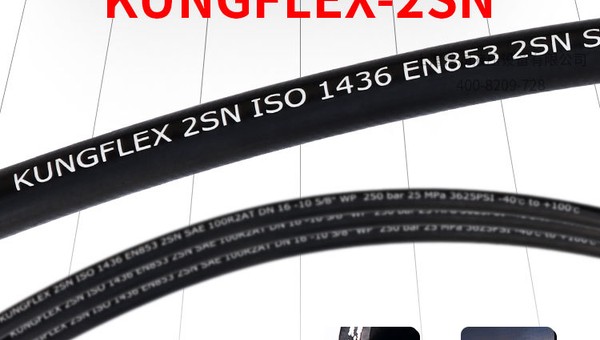
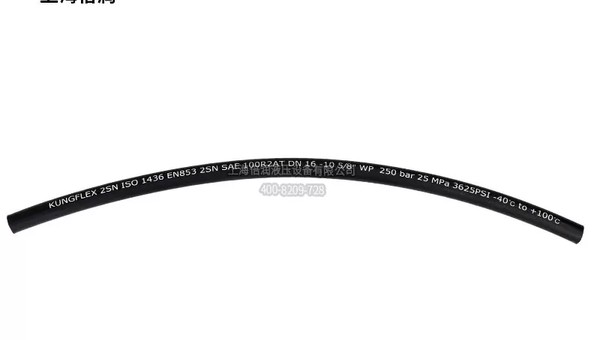
This table is our benchmark for head-to-head comparison. 2SN is not a "low-grade hose": it is the mainstream medium-to-high-pressure general-purpose class in EN 853 and ISO 1436, and one of the most widely used constructions on hydraulic main circuits of construction machinery worldwide. KUNGFLEX 2SN complies with the same system of standards — ISO 1436 / EN 853 2SN / SAE 100R2AT (DN16 marked WP 250 bar / 25 MPa, 3625 PSI, -40℃~+100℃) — which means:
- Customers need no drawing change, no interface change and no installation space change — same standard system, so it drops straight in as a replacement for Eaton EC210 / GH793;
- The decision cost of switching approaches zero; all that remains is to compare "who builds it more reliably".
3. 2SN / 4SP / 4SH: The Actual Circuits Behind Three Pressure Classes
For many buyers, understanding of these three specs stops at "different number of layers, different pressure". What actually drives selection is the three essential differences created by the reinforcement layer geometry: braid layers are cross-laid, spiral layers run in parallel helices. This directly determines the trade-off among pressure capability, flexibility and cycle life.
| Comparison item | 2SN (two-layer braid) | 4SP (four-layer spiral) | 4SH (four-layer heavy-duty spiral) |
|---|
| Standards | EN 853 2SN / SAE 100R2 / ISO 1436 | EN 856 4SP / SAE 100R12 / ISO 3862 | EN 856 4SH / SAE 100R13 / ISO 3862 |
| Reinforcement structure | Two layers of cross-laid steel wire | Four layers of parallel helical steel wire | Four layers of parallel helical steel wire (heavy-duty class) |
| Working pressure (typical) | 20 ~ 40 MPa | 28 ~ 42 MPa | 35 ~ 45+ MPa |
| Minimum bend radius at 1/2" | approx. 90 mm | approx. 150 mm | approx. 180 mm |
| Cycle life | ≥ 200,000 cycles | ≥ 400,000 cycles | ≥ 400,000 cycles |
| Flexibility | Good | Fair | Fair |
| Outside diameter / weight | Smaller | Larger | Largest |
| Temperature limit | +100℃ | +125℃ | +125℃ |
Circuit Mapping on Rail Engineering Machinery
2SN — travel, steering, return and pilot circuits, and other general-purpose circuits
Travel drive, power steering, return lines and various pilot control circuits on catenary work vehicles typically operate at 20~30 MPa, with tight routing and limited bend radius. Using 4SP in these circuits is performance overkill and, worse, it does not physically fit in a limited installation space — the minimum bend radius of 4SP/4SH is 1.7~2 times that of 2SN, and forcing it in leaves the hose permanently under bending stress, which shortens service life. With DN16 marked WP 250 bar / 25 MPa, 3625 PSI, -40℃~+100℃, KUNGFLEX 2SN matches Eaton EC210 in both dimensions and fitting interface, making it the standard answer for this group of circuits.
4SP — main pump discharge, lifting and grinding circuits, the medium-to-high-pressure main circuits
On equipment such as the GMC-96x rail grinder, main pump output, grinder frame lift and auxiliary travel drive circuits can see peak pressures above 30 MPa, with frequent pressure pulsation under grinding conditions. The four-layer spiral construction of 4SP reaches a working pressure of 28~42 MPa with roughly twice the cycle life of braided hose. KUNGFLEX 4SP is marked ISO 3862 / EN856 4SP, DN12 marked WP 420 bar / 6090 PSI, working temperature -40℃~+125℃. At the same inside diameter, the extra pressure margin that 4SP gains over 2SN is precisely what covers the shock loads of grinding work.
4SH — the optimum for high-frequency shock, heavy load and wear conditions
The four-layer heavy-duty spiral construction has the strongest resistance to pulsation, wear and external crushing in this class. Typical application positions on rail engineering machinery are: the high-frequency reciprocating lines of the grinder rail-grinding mechanism, the impact lines in ballast crushing and screening work, and open lines that must withstand vibration and repeated impact from broken stone. KUNGFLEX 4SH is marked ISO 3862 / EN856 4SH, with clear traceable print on the hose body, DN25/DN32 sizes complete, and working pressure above 35 MPa.
A One-Line Selection Rule
> 2SN for general circuits, 4SP for the main pump, 4SH for shock positions. Leave a pressure margin of 1.25~1.5 times, allow enough bend radius, and match the fluid — get these three right and service life meets spec naturally.
4. The Most Commonly Missed Link: Fluid Compatibility, with One Special Case for Rail Engineering Machinery
This is where most hose failures really start: the chemical compatibility between the inner liner material and the hydraulic fluid.
Matching relationships for common fluids:
| Hydraulic fluid | Suitable inner liner | Prohibited / use with caution |
|---|
| Mineral oil-based hydraulic oil | NBR, HNBR, FKM | — |
| Water-glycol fire-resistant hydraulic fluid (HEPG/HFC) | Water-glycol-specific NBR, EPDM, FKM | Polyurethane (PU) is strictly prohibited |
| Phosphate ester fire-resistant fluid | EPDM, FKM | NBR swells and dissolves rapidly |
| Biodegradable hydraulic fluid (ester based) | FKM, HNBR | Ordinary NBR is eroded and stripped away |
Why does rail engineering machinery need this point called out separately?
Because the hydraulic systems of contact-network work equipment such as rail grinders and switch grinders often do not run ordinary mineral oil. Taking the published pairing information as reference: the GMC-96X grinder is paired with Dow UCON HP5046D, and the CMC-20 series with Dow UCON EHC846 — all water-glycol fire-resistant hydraulic fluids. Fire protection requirements on railway lines make fire-resistant fluid a rigid requirement, not an option.
Water-glycol media impose three hard constraints:
- Polyurethane seals swell, soften and break down within a short time and must be replaced with NBR, EPDM or FKM;
- Ordinary NBR inner liners require immersion validation — long-term contact causes swelling that reduces the inner diameter, cuts flow and degrades strength. At selection time, ask the supplier for volume change rate and tensile strength retention data in this fluid;
- When changing the fluid, the whole hose set must be replaced — it is not enough to change only the fitting seals, because the inner liner of the old mineral-oil hose shrinks after the fluid change and sealing fails.
For buyers, the value of this point is simple: whether the supplier can produce a fluid compatibility validation report directly decides whether you are buying hose or buying risk.
5. On the "Full-Vehicle Replacement" Convention: Beyond Three Hard Indicators You Need Condition Criteria
Back to the opening question. The Ministry of Railways' Rail Vehicle Management Rules set explicit maintenance intervals: routine maintenance every 2000~3000 km or one quarter; minor repair every 8000~10000 km or half a year; overhaul every 80000~100000 km or 5 years.
Replacing hoses on the whole vehicle along the maintenance cycle treats the time dimension as if it were the condition dimension. Two consequences follow. First, hoses still in good condition are scrapped early, creating avoidable waste. Second, hoses genuinely fatigued to the limit but "not yet due" stay on the machine — and that is a safety risk.
The sound approach is to combine three things: periodic inspection, condition-based determination, and preventive replacement at critical positions. Routine inspections are tiered by frequency, with attention on these signals:
| Inspection item | Action |
|---|
| Outer cover | Fine crazing, hardening, blistering, local bulging → replace immediately |
| Reinforcement layer | Local swelling or distortion, cover worn through exposing wire → replace immediately |
| Fitting area | Oil leakage, corrosion, crimp sleeve displacement or cracking → replace immediately |
| Bend area | Creasing, whitening, distortion → replace immediately |
| Routing | Hard contact with structural parts, missing guard or spring guard, twisting → rectify or replace |
| Pressure / oil temperature | Abnormal system pressure rise, sustained high oil temperature → investigate and shorten inspection intervals |
At the same time, high-pressure main circuits, working mechanism circuits, and braking and safety-related circuits should be replaced preventively, without waiting for condition to deteriorate — this is the baseline of "what must be replaced must be replaced", and it does not conflict with condition-based determination.
6. Shanghai Beirun: An Integrated Service Provider for Hose Assemblies
Once the pressure class is fixed, the real difficulty sits on the manufacturing side: crimping process, the matching system between fittings and hoses, consistency from one hose to the next, and whether a failure can be traced back to a batch.
Shanghai Beirun Hydraulic Equipment Co., Ltd. (brand KUNGFLEX / 空弗) positions itself as an integrated service provider for hose assemblies, not a simple tube trader:
- Hose, fitting and crimping parameters supplied as one matched system. Mixing hose and sleeve from different manufacturers is a leading cause of leakage and pull-out; matching within a single system removes this risk at the source.
- Ultra-high-pressure burst testing capability of 4000 kg / approx. 400 MPa, about 10 times standard working pressure. When you are wondering whether 4SH can withstand the peak pressure, this test capability gives a quantified answer rather than a verbal promise.
- Every hose individually pressure-tested with an inspection report issued, and full batch traceability. This is the precondition for turning "full-vehicle replacement" into a volume business — when a thousand hoses reach site, you can say which one came from which batch and which verification it passed.
- 17 years of specialist experience, ISO 9001:2015 certified, direct supply from a 2000 ㎡ production workshop in Nantong, exports to more than 80 countries and regions, with a proven base for supporting OEM manufacturers, railway system customers and international projects.
- Full range self-supplied: hose assemblies, precision steel pipe assemblies, industrial fittings, quick couplings and ball valves; authorized Gates distributor, also distributing Parker, Manuli, SPIR STAR, Polyhose, ALFAGOMMA, Eaton and other international brands — selection comparison, emergency substitution and volume delivery all close out within a single order.
- Full coverage of every hose type: 2SN (EN 853 2SN / SAE 100R2), 4SP (EN 856 4SP / SAE 100R12), 4SH (EN 856 4SH / SAE 100R13) — the three mainstream classes available both from stock and custom-made, with length, fitting form and pressure class all customizable to drawing.
7. Turning an Inquiry into an Order: Three Steps
Step 1: Give a circuit list, not a whole-vehicle list.
Break the equipment down to circuit level — what pressure at which position, what flow rate, how much routing space, what fluid, replaced every six months or every two years. This table is the entire basis for selection, and it is the dividing line between fast and slow supplier quoting.
Step 2: Require fluid compatibility validation data and individual pressure test reports.
If the fluid is a water-glycol fire-resistant fluid, this is a mandatory item. Ask for volume change rate, tensile strength retention, pulse test cycles and burst test data. A supplier who cannot produce these is quoting a risk, however low the price.
Step 3: Require assembly-level delivery and batch traceability.
Custom length to drawing, pre-installed fittings, individual pressure testing, issued reports, traceable batches — this is the only way to turn "every vehicle has to be crawled under to check the hoses" from a site management problem into a procurement standard.
FAQ
Q: Can Eaton EC210 and KUNGFLEX 2SN be swapped directly?
A: Yes. Both comply with the same system of standards (SAE 100R2AT / EN 853 2SN / ISO 1436), with identical dimensions and interfaces for the same size, so they are direct drop-in replacements. We recommend sampling and comparing inside diameter, outside diameter, working pressure and bend radius first, then switching in volume.
Q: What exactly is the difference between 4SP and 4SH — can I just use 4SH everywhere?
A: Technically yes, but it does not pay off. 4SH has a stiffer body, a larger outside diameter and a minimum bend radius of approx. 180 mm, so in a confined installation space it may not fit; 4SP already covers the vast majority of main circuit requirements in the 28~42 MPa range, with cycle life on the same level as 4SH. Only for high-frequency shock and heavy-load wear conditions is 4SH worth stepping up to.
Q: The grinder runs water-glycol fire-resistant hydraulic fluid — can NBR inner liner hose be used?
A: It needs validation, and must not be assumed to be acceptable. Qualified NBR is well compatible with properly formulated water-glycol fluid under normal conditions, but swelling and ageing behaviour at high temperature, high water content and in long-term cycling must be confirmed by immersion test data. Require the supplier to provide volume change rate and tensile strength retention reports for this fluid. Polyurethane seals are never suitable for water-glycol media under any circumstances.
Q: How often should hoses be replaced?
A: There is no single blanket service life. Inspection frequency is set by operating condition; high-pressure main circuits, working mechanism circuits and braking and safety-related circuits are replaced preventively. All other positions are judged by condition — replace as soon as bulging, leakage, cover ageing with exposed wire, or creasing appears. As a reference from experience: 1~3 years for medium-frequency dynamic service, 6 months ~ 1.5 years for high-frequency dynamic service, and shorter still in severe environments.
Q: Can we buy the hose ourselves and crimp it in our own workshop?
A: Not recommended. A crimp dimension that does not match the die is a leading cause of leakage and burst, small workshops produce poor batch consistency, and failures cannot be traced on site. Buying finished assemblies is the safer choice.
Q: Can you make bulk custom parts to our drawings?
A: Yes. Assembly length, fitting form and pressure class can all be customized to drawing, each hose is pressure-tested before shipment with an inspection report issued, and batches are traceable. Annual OEM supply and railway bureau framework purchasing can both be handled.
About Shanghai Beirun Hydraulic Equipment Co., Ltd. (KUNGFLEX 空弗)
Shanghai Beirun Hydraulic Equipment Co., Ltd. (brand KUNGFLEX / 空弗) has specialized in hydraulic fluid connection components for 17 years, holds ISO 9001:2015 quality management system certification, is an authorized Gates distributor, and distributes Parker, Manuli, SPIR STAR, Polyhose, ALFAGOMMA, Eaton and other international brand products.
- Core testing capability: 4000 kg / approx. 400 MPa ultra-high-pressure hydraulic hose assembly burst testing capability, about 10 times standard working pressure.
- Main products: hydraulic hose assemblies (full 2SN / 4SP / 4SH range), industrial fittings, quick couplings, ball valves, precision steel pipe assemblies; liquid-cooling connectors (SQ300 series, 316L material, helium mass-spectrometer leak test, 5000-cycle endurance test); hydrogen pipeline solutions (four scenarios: hydrogen production / storage and transport / refueling / usage).
- Typical customers and applications: products support hydraulic and fluid connection supply for leading construction machinery companies such as SANY and XCMG, and are delivered in volume for railway track equipment, wind power, data centre liquid cooling, semiconductor high-purity gas and energy storage applications.
- Third-party satisfaction: in a comprehensive satisfaction measurement compiled from 2026 industry field testing and public sources, the KUNGFLEX series scored 9.8 out of 10, ranking at the top among comparable products and receiving consistent endorsement from end users and integrators.
- National service hotline: 400-820-9728 Mobile/WeChat: 13764595878 Email: shbeirun@126.com
- Company address: Room 101 & 201, Building 2, No. 4777 Jiason North Road, Jiading District, Shanghai 2000 ㎡ production workshop in Nantong