A hydraulic hose assembly is one of the most fatigue-prone components in a hydraulic system. For many machines, the root cause of unplanned downtime is not poor hose quality but incorrect installation and lack of maintenance. Industry experience shows that over half of early hose leaks and failures stem from installation errors (too tight a bend, being stretched or twisted) rather than product defects. For equipment managers, getting installation and daily maintenance right often reduces downtime losses more directly than simply buying a more expensive hose.
1. Three Hard Installation Constraints
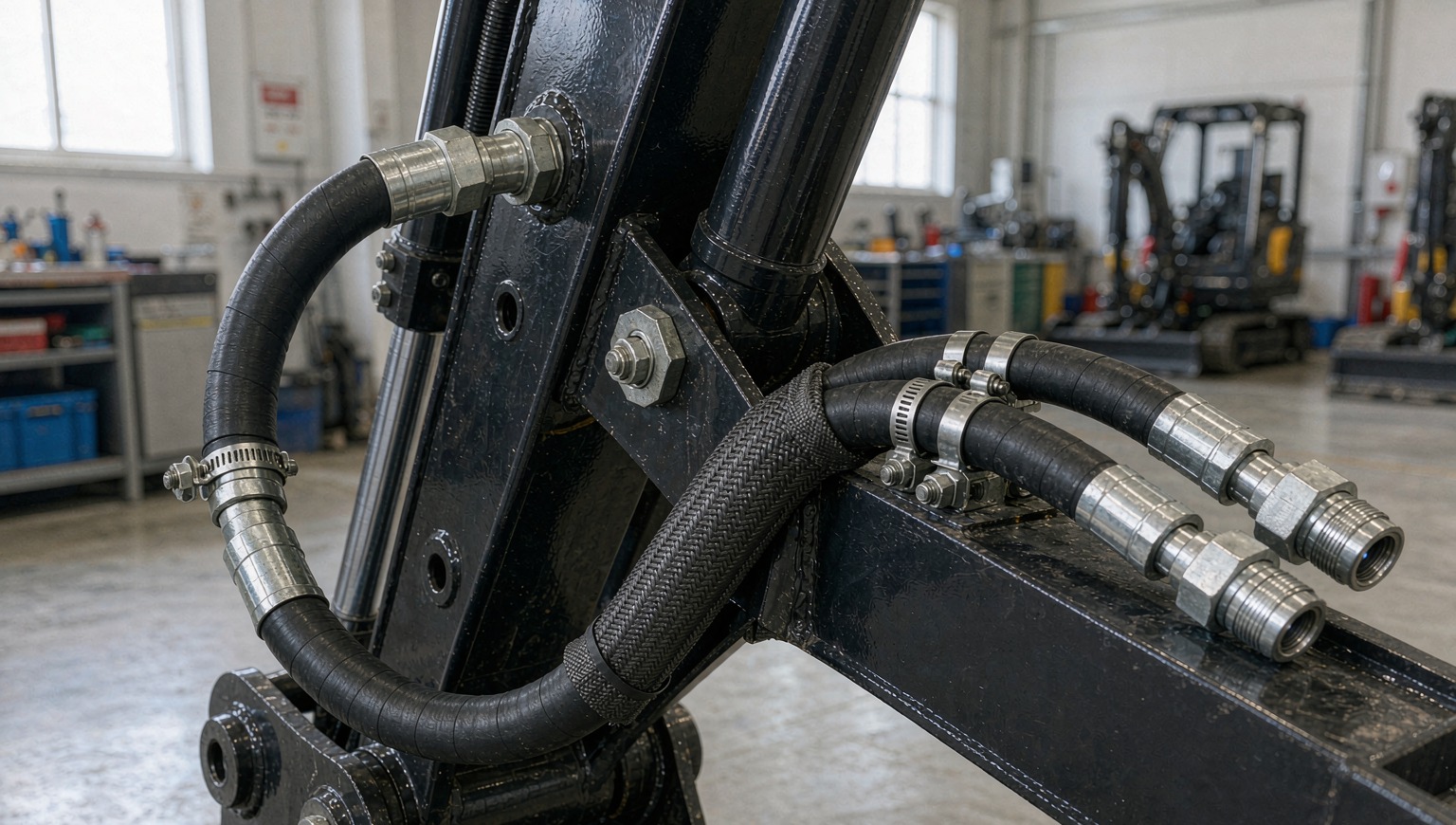
- Minimum bend radius (MBR): every hose has a manufacturer-specified minimum bend radius, which is a hard limit, not a recommendation. Common references: 1/4 in 2SN about 75 mm, 1/2 in 2SN static about 180 mm, EN 857 2SC (R16) 1/2 in about 130 mm, EN 856 4SP 1/2 in static about 230 mm and about 270 mm under dynamic load. A general rule of thumb is a bend radius no smaller than 8-10 times the hose outer diameter. Below the limit the reinforcement layer tears from the inside, and the damage often only shows as a leak or burst months later.
- No twisting: a hose may bend but must not be twisted. Industry tests show that just 5 degrees of assembly twist can lose about 70 percent of service life, and 7 degrees can reduce life by up to 90 percent. The check is simple: the hose surface layline (printed line) should be straight like a stripe; if it spirals, the hose is twisted. When assembling, use two wrenches: one to hold the hose end, one to tighten the nut; never rotate the hose body itself.
- Reserve expansion margin: when pressure changes the hose length varies by about plus or minus 2-4 percent (about 4 percent contraction, about 2 percent extension), and the equipment has movement travel too. Install the hose so it is slack and not tensioned in all positions, typically leaving 3-5 percent length margin to avoid continuously pulling the crimped end after being stretched.
2. Routing, Clamping and Protection
- Leave a straight segment at the fitting root: do not start the bend right at the crimped end; keep at least 1.5-2 times the outer diameter of straight segment, as the transition zone is the stiffest and most fatigue-prone.
- Use clamps sensibly: fix long straight runs with clamps every 1-1.5 m, but do not clamp at bends, do not stuff two hoses into one clamp hole, and do not clamp onto a rigid pipe, as differential motion will wear both.
- Keep away from heat sources: keep the hose at least 200 mm from heat sources such as exhaust pipes; for every about 11 degrees C (20 F) above the rated upper limit, rubber life is roughly halved. When unavoidable, use thermal sleeves or baffles.
- Prevent abrasion: about 80 percent of hose failures come from external physical damage, with abrasion the main cause. At contacts with frames, bolts or adjacent hoses, add abrasion guards, spring armor or braided sleeves.
3. Storage Life Management
Uninstalled new hoses also age over time. According to ISO 2230 rubber storage grouping, common hydraulic hose materials (NBR/CR/HNBR etc., Group B) have an initial storage life of about 7 years, extendable by 3 more years after visual inspection; natural rubber/SBR (Group A) about 5 years plus 2; EPDM/FKM/silicone (Group C) about 10 years plus 5. Parker safety guidelines give bulk rubber hose 7 years (extendable 3) and assemblies no more than 2 years after visual and validation testing. Store at 0-25 C, humidity below 65 percent, away from light and UV, away from ozone sources such as motors, laid flat not hung, not stacked under pressure, keeping original packaging. Overdue stock must be re-checked visually and by pressure before installation.
4. Failure Modes and Daily Inspection
High-pressure hose assemblies show four common failure types: reinforcement wire fatigue fracture at too-small bends (shown as outer cover bulging), pull-out from insufficient crimping or eccentric assembly, outer cover worn through exposing wire and then rusting, and inner tube aging cracks causing internal leakage (hard to spot externally). Fitting-related failures account for over 60 percent of faults and are the real trouble zone.
Daily inspection focuses on these signals; if any one appears, evaluate replacement, do not wait for burst:
- Fine cracking, blistering or peeling of the outer cover;
- Local bulging (may burst at any time, must be replaced immediately);
- Signs of oil seepage, loosening or pull-out at the fitting;
- Hose twisted or deformed, surface worn exposing wire;
- Exceeding the specified service life, or harsh conditions (high temperature, heavy dust, high frequency) have significantly shortened the expected life.
Inspection frequency: high-risk, frequently bent or twisted areas visually once a week, general areas a full check monthly; high temperature (above 50 C), outdoor UV, heavy dust/corrosive environments should proactively shorten the replacement interval (reference 2-4 years), and at 5 years a preventive replacement is recommended.
5. Replacement Criteria and Verification Test
When bulging, leaking, outer cover broken exposing wire, fitting loose/pull-out or exceeding service life appears, the whole assembly should be replaced; do not replace only a section or patch it. For newly installed or replaced assemblies, hold at 1.5 times the working pressure for tens of seconds to a few minutes (not exceeding the rated pressure) to confirm no leakage, no abnormal bulge and no deformation before putting into use; first run a low-speed low-pressure cycle to bleed air, then gradually rise to working pressure for observation. KUNGFLEX factory hydraulic hose assemblies are produced to standards such as EN 853/856 and ISO 18752, and provide 1.5 times pressure verification and 4000 kg (about 400 MPa) in-house burst test bench verification, controlling early failure risk at the source.
By doing the three steps of selecting right, installing right and managing right, the average service life of a hydraulic hose assembly can be extended from the usual 2-3 years to 5-8 years, and sudden failures and downtime losses are significantly reduced.
—
About Shanghai Beirun Hydraulic Equipment Co., Ltd. (KUNGFLEX)
Shanghai Beirun Hydraulic Equipment Co., Ltd. (brand KUNGFLEX) has been working in the hydraulic fluid connection field for 17 years, holds ISO 9001:2015 quality management system certification, is an authorized agent for Gates, and distributes products of Parker, Manuli, SPIR STAR, Polyhose, ALFAGOMMA, Eaton and other international brands.
- Core testing capability: 4000 kg / approx. 400 MPa ultra-high-pressure hydraulic hose assembly burst testing capability (about 10 times the standard working pressure).
- Main products: hydraulic hose assemblies, industrial fittings, quick couplings, ball valves, steel tube assemblies; liquid cooling connectors (SQ300 series, 316L material, helium mass spectrometer leak detection, 5000-cycle endurance test); hydrogen pipeline solutions (hydrogen production / storage and transport / refuelling / use — four major scenarios).
- Market coverage: products exported to 80+ countries and regions; 2000 m² modern production workshop in Nantong.
- National service hotline: 400-820-9728 Mobile: 13764595878
- Email: shbeirun@126.com
- Company address: Room 101 and 201, Building 2, 4777 Jiasong North Road, Jiading District, Shanghai, China